

/image%2F1034110%2F20221028%2Fob_0c2a43_thumbnail-13.jpeg)
_________________________________________________________
Goodbye Senhor Saramago
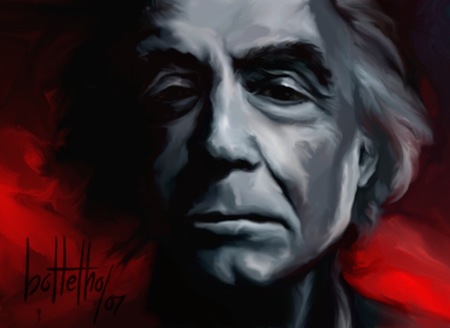
“I insist that everything is biography. Everything is life: lived, painted and written.” José Saramago
Saramago is a wild herbaceous plant whose leaves, in difficult times, served as nourishment for the poor. Saramago is also a literary genius. These definitions are not mutually exclusive since José Saramago, the Portuguese writer who died this morning, also wrote these lines:
“We forget that we pervert reason when we humiliate life, that human dignity is insulted every day by the powerful of our world, that the universal lie has replaced the plural truths.”
Saramago was born in Portugal in 1922. His family couldn’t afford grammar school or books, and Saramago had little formal education:
“I had no books at home. I started to frequent a public library in Lisbon. It was there, with no help except curiosity and the will to learn, that my taste for reading developed and was refined.”
At 13, he trained to become a car mechanic and spent the next three decades working as a locksmith, at a metal company and in a welfare agency, publishing his first novel in 1947 with no success.
He joined the Communist Party- his political views were shaped immensely by growing up during the period of time when the fascist militias and secret police were active in Portugal- and directed a national newspaper. After the failure of a leftist coup in 1975, he became unemployable. This proved to be a blessing in disguise since it finally forced him to turn to literature to survive. Fame followed when the Swedish Academy awarded him the Nobel prize in literature in 1998. “Here was a writer” they said “who with parables sustained by imagination, compassion and irony continually enables us once again to apprehend an illusory reality”.
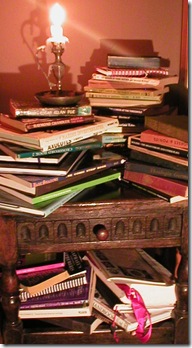 Books
Books
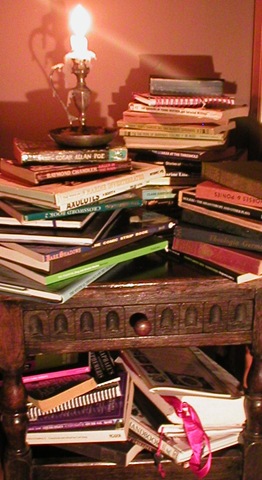
I met Saramago by accident in the pages of “The Year of the Death of Ricardo Reis”. I was not looking for him yet I found him, and rarely have I been so stunned and inspired by a writer.
There are piles of books in disarray by my bedside – I am mostly a nocturnal reader – and because I am also an eclectic reader and an avowed magazine junkie, French poetry, cookbooks, fashion magazines, quotation books and several novels, all clamor for my attention in the few hours I devote to reading in bed before I am stolen by sleep.
Once they are read, some of these books are moved to the hallway shelf or the living room where they will remain- acquaintances with whom I have established a rather distant rapport. Others, like trusted lovers, will not leave the bedside. “The Year of the Death of Ricardo Reis” is such a book. We have had a rather lengthy relationship since I bought this paperback in the early 2000. It is always within my reach. I can open it at any page and invariably find a treasure that will delight me. It never disappoints. Poetic, musical, erudite, it is written in a stream-of-consciousness style with long flowing sentences and undifferentiated dialogue in paragraphs running over several pages (think of Proust or Joyce). There is no plot, or hardly; the novel traces the last days of a poet and doctor haunted by the spirit of the great Portuguese poet, Fernando Pessoa. Ricardo Reis then, returns to Lisbon after sixteen years in Brazil. He stays at a hotel, falls in love with a young girl with a paralyzed left arm, has an affair with a maid, takes lots of walks, reads lots of newspapers, rents an apartment…You see, nothing… All we do is follow the days and ruminations of Ricardo Reis and yet, the way in which Saramago describes the small gestures, the seemingly insignificant conversations, and the looks between the characters is brilliant. They constantly talk past each other and misunderstand one another without realizing it and we become aware of the deep complexities in the relationships. Love, loneliness, truth, death are the recurrent themes of this magnificent novel. I hope it will find its way by your bedside one of these nights. It will bring you, perhaps not joy – although Saramago’s sarcastic asides have made me laugh outloud – but I promise you enlightenment.
I read this morning that Saramago died in the company of his family, saying goodbye in “a serene and placid way.”
Goodbye Senhor Saramago. Goodnight, sweet prince. Tonight like every night since 2003, you are at my bedside. Your words, the last I read tonight:
“Meanwhile the guest returns to the reception desk, somewhat out of breath after all that effort. He takes the pen and enters the essential details about himself in the register of arrivals, so that it might be known who he claims to be, in the appropriate box on the lined page. Name, Ricardo Reis, age, forty-eight, place of birth, Oporto, marital status, bachelor, profession, doctor, last place of residence, Rio de Janeiro, Brazil, whence he has arrived aboard the Highland Brigade. It reads like the beginning of a confession, an intimate autobiography, all that is hidden is contained in these handwritten lines, the only problem is to interpret them.”
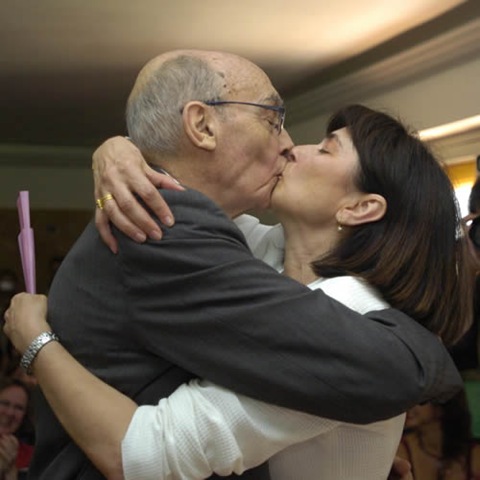
Here is my favorite photograph of José Saramago with his wife Pilar del Rio. 20 years of love and a passionate kiss.
In his Nobel acceptance, Saramago paid tribute to the wisest man he ever knew, his illiterate grandfather, Jerónimo Meirinho, and to his grandmother, Josefa Caixinha, who at the end of her life said: “The world is so beautiful and it is such a pity that I have to die”. You may read the entire speech here:
http://www.lidous.net/2010/06/19/goodbye-senhor-saramago/
Michèle Voltaire Marcelin


/https%3A%2F%2Fi.ytimg.com%2Fvi%2FR66fhcoBdXs%2Fhqdefault.jpg)
/image%2F1034110%2F20260910%2Fob_8b6bf4_ae87b8d0f8dd44abbcfa9faacf3f4e5b.jpg)
/https%3A%2F%2Fi.ytimg.com%2Fvi%2FXuVVsSWXcXk%2Fhqdefault.jpg)
/https%3A%2F%2Fi.ytimg.com%2Fvi%2FfB9O9Zno0SM%2Fhq2.jpg)
/https%3A%2F%2Fi.ytimg.com%2Fvi%2FODg2eKnl4Ys%2Fhqdefault.jpg)
/https%3A%2F%2Fi.ytimg.com%2Fvi%2FR66fhcoBdXs%2Fhqdefault.jpg)
/image%2F1034110%2F20260919%2Fob_9f63f6_mail.jpeg)
/image%2F1034110%2F20260919%2Fob_1983de_mail-1.png)
Commenter cet article